

Today we are beginning our annual tradition of getting to know the animators at the Sundance Film Festival. First up is Andy and Carolyn London, animators of the short 1981
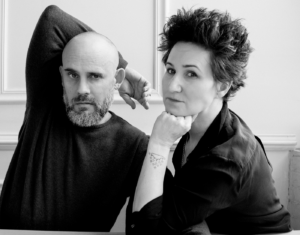

How did you two meet and get into animation?
AL: We met in Prague in 1996, in the beginning of ’96. And Carolyn had appendicitis and we couldn’t pay the hospital bill and somehow we left the country and we’ve been living in New York ever since. Yeah.
CL: That’s a little bit… That’s not quite the answer.
CL: We were both English teachers in the Czech Republic in the early 90s, and we met at the same school in Prague. And at the time, Andy was making graphic novels and I had experience. I was working in theater before I came to Eastern Europe. When we came back to New York, I was still working in theater. I was a playwright…so we decided, at a certain point, what would happen if we started to put our talents together. And so we made a short. We were then commissioned to make a music video, an animated music video for a musician friend of ours and it ended up getting picked up by MTV and it was the first thing that we did
Why don’t you tell the audience a little bit about 1981?
CL: 1981, it’s a coming of age, death of innocence story of a 14-year-old boy who’s having a birthday party. I don’t think I want to spoil it for the audience, but the parents, they have a very big surprise for him that really changes everything for him. And just a note, it’s based on an actual event. Obviously, we have creative liberty and we changed some of the story and the characters, but it was based on something that happened in Long Island in 1981. And that’s why we call it 1981.
How did you get the idea for it?
AL: Sure. Well, at the time I was working on some graphic novel material and I started something called Animation Speakeasy with a couple of colleagues. And it’s this bi-monthly event where we bring in animators and they don’t talk about their own work. They bring in their favorite animated short film. And through that, I just got really, really super inspired to get back to animating again because I was looking at all these amazing, just these niche animated shorts and I was like, this story that happened to me when I was a kid, it just feels like it should be a film. And I started working on it and then Carolyn’s like, move over, and she helped me start shaping it. And that’s how it always… A lot of our projects are like that where one of us will initiate something and the other person will kind of jump in there and help shape it
How did you decide on the visual style of the animation?
AL: It was a lot of what we call pencil testing, where we tried out multiple techniques. We wanted to create something that felt like a memory where all the details are not there. And we’re looking for something that just had a feel of the late 70s and the early 80s. I found old office paper for collaging in the backgrounds and did tons of research at vintage shops and took many photographs and tried to emulate that time period and step back into it. That’s how it was for me
CL: Yeah, for sure. And I would just add that I think what Andy said is exactly right, which is, we’re putting it through this prism of, how do you conjure up a memory? And a lot of the film for us is interrogating that idea that, there’s things that happen to you in your life at certain times and they become these imprints or these touchstones and you end up thinking about them for the rest of your life and they end up shaping you in some way.
And those memories are watercolory. They’re kind of ambiguous. They have a lot of emotional color, but they don’t always have a lot of detail. And so that feeling we were really trying to get to…
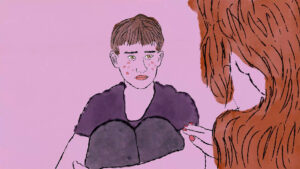


What made you decide when the dancer appears, everything becomes very pink? What made you decide to go with pink?
CL: I think it’s because it’s almost like the color of memory… I think sometimes these things are subconscious and you don’t know why you choose them… But I think everybody looks good in pink. Secondly, it’s kind of like the color of… There’s a switch. There’s a switch between the the regular life and then there’s this kind of performance life that happens. And you have to kind of create a stage. And so some of that is just what do you do to visually create a stage?
AL: Also just a note, when I was that age, I remember seeing Ralph Bakshi’s Lord of the Rings. And there was a scene with Boromir, one of the characters, his last stand where they kill him. And it never left me. And it was this where you would have these white eyes and these white teeth against these weird, sinewy colors, these dark colors. And I think that definitely seeped into a lot of the color tests that we did.
Congratulations. What do you hope that people take away from the short?
CL: Honestly, for me, I think it’s, I want them to be disturbed but also in love. I want there to be those complex feelings that you feel where you might be really unsettled, but it’s also maybe really beautiful. And at least for me, those feelings when things are complicated like that and they live side by side is when I feel we’ve made a really successful film.
AL: Yeah. I also I want to have audience members really get inspired by it and maybe inspire them to make animated shorts as well. So I think that was a big part of why it’s great to make shorts because you become part of that community.
You can watch the full interview with Andy & Carolyn below and if you are attending the festival make sure to check out 1981 as part of the Animated Short Film Program.
